Your guide to German visas
and residence permits
Work, study, family or a long-term future: Germany has different routes for different plans. This guide explains the main options, who they suit, how long they last and what work they allow.
Jump to: Permanent residence · Work · Business & family · Study · Job search
Start with your nationality, qualifications and reason for moving. The right route follows your circumstances.
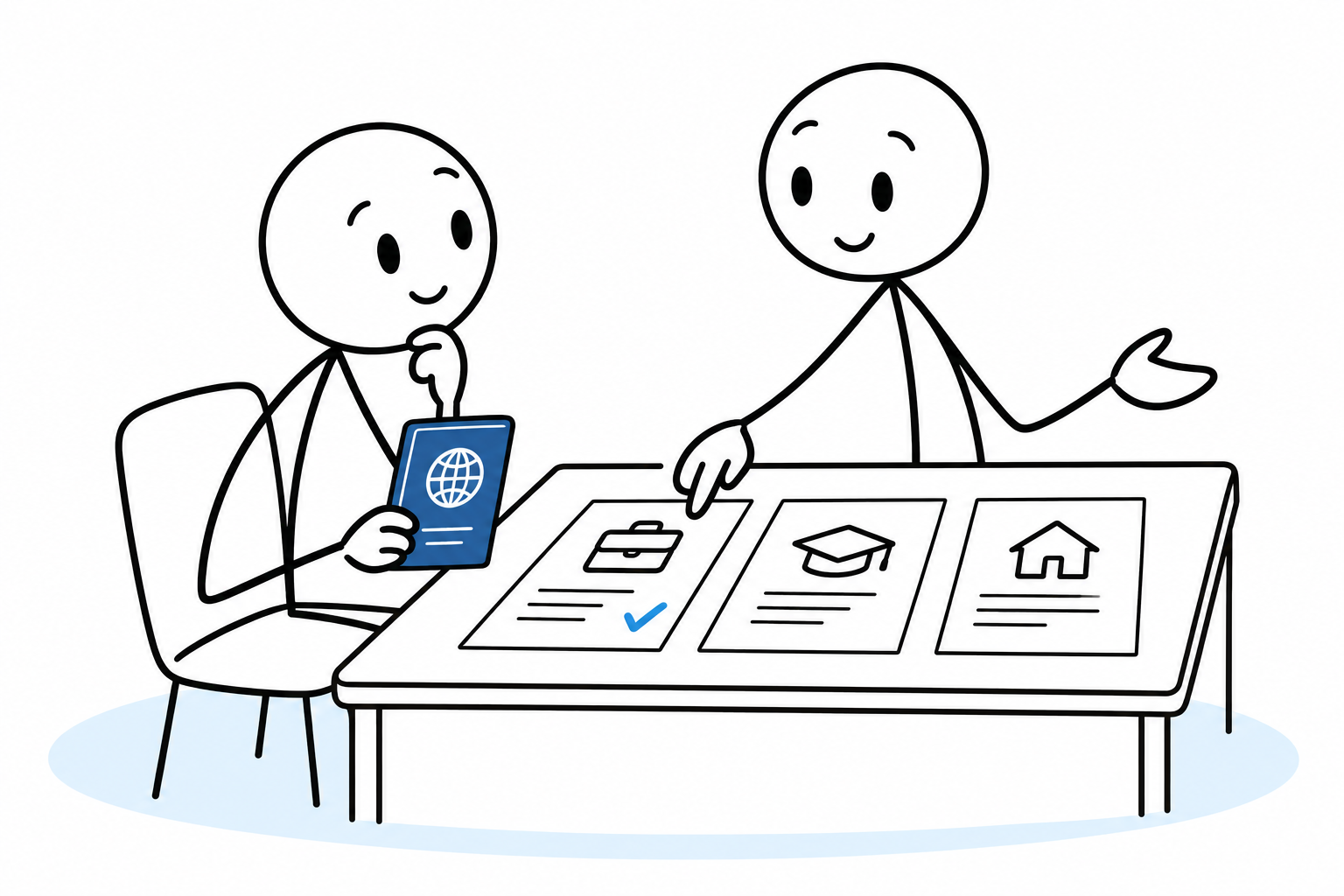
First: a visa and a residence permit are different
A national entry visa usually lets you travel to Germany for your intended long-term purpose. A residence permit governs your stay afterwards. A short-stay Schengen visa normally covers up to 90 days in a 180-day period; it is not a general route to living and working here.
EU and EEA citizens generally use freedom of movement rather than these visa routes. Swiss citizens have separate arrangements. For other nationalities, whether you must obtain a visa before travelling depends on your passport and purpose. Visa-free entry does not automatically allow you to start work.
Official guidance: Read the requirements →
For an established life in Germany
Permanent residence is usually something you build towards after living here. These titles are indefinite, but conditions about absence and loss of status still apply.
Settlement permit
Who it suits: People already established in Germany. The general route normally requires five years with a residence permit, secure livelihood, 60 months of pension contributions or comparable provision, sufficient German, suitable housing and other conditions.
How long: Indefinite.
Work rights: Employment and self-employment are permitted.
Official guidance: Read the requirements →
EU long-term residence
Who it suits: People with normally five years of qualifying residence, stable income, sufficient German and the other statutory requirements. It can make a later move to participating EU countries easier, subject to their rules.
How long: Indefinite.
Work rights: Work is permitted in Germany. It does not automatically authorise work everywhere in the EU.
Official guidance: Read the requirements →
Some routes are faster: qualifying skilled workers can often apply after three years and 36 months of pension contributions. German graduates can have a two-year route with 24 months of contributions. EU Blue Card holders may qualify after 27 months with A1 German, or 21 months with B1. The other conditions still matter.
Official guidance: Read the requirements →
For a job in Germany
EU Blue Card
Who it suits: People with a qualifying higher-education qualification and a matching job offer lasting at least six months. In 2026, the normal gross annual salary threshold is €50,700. A lower €45,934.20 threshold applies to eligible shortage occupations and recent graduates, generally with Federal Employment Agency approval. Certain experienced IT professionals can qualify without a degree.
How long: Up to four years; a shorter contract normally means the contract length plus six months. Renewable.
Work rights: The qualifying job. During the first 12 months, a change of employer must be reported and can be checked.
Official guidance: Read the requirements →
Skilled-worker permit
Who it suits: People with a recognised vocational qualification or recognised/comparable degree and an offer of qualified employment. The job does not always have to match the qualification; regulated professions require the relevant licence. For first-time employment entry over age 45, the 2026 salary requirement is €55,770, unless adequate pension provision is shown.
How long: Up to four years; shorter contracts normally receive the contract length plus six months. Renewable.
Work rights: The approved employment, subject to the conditions on the permit.
Official guidance: Read the requirements →
Other routes into qualified work
Experienced-worker route
Who it suits: People entering non-regulated work with a qualification recognised in its country of issue, normally at least two years of relevant experience within the past five years, and a job offer. The 2026 minimum salary is €45,630, with a collective-agreement exception. Additional rules apply above age 45; IT has a qualification exception.
How long: Temporary, for the approved employment; extension depends on continuing eligibility.
Work rights: Approved employment, normally with Federal Employment Agency approval.
Official guidance: Read the requirements →
Recognition partnership
Who it suits: People who have a qualifying foreign qualification and an employer willing to support recognition after arrival. Normally you need at least A2 German, a job offer and a written recognition agreement.
How long: Initially up to one year; renewable up to a total of three years.
Work rights: Approved work alongside recognition, plus a secondary job of up to 20 hours weekly. Regulated professions may initially allow only assistant work.
Official guidance: Read the requirements →
For your business or your family
Self-employment and freelance work
Who it suits: Entrepreneurs with a viable, financed business that meets the economic-interest or regional-demand tests; or qualifying freelance professionals with sufficient resources and any required professional permission. Adequate retirement provision can matter above age 45.
How long: Initially up to three years; renewable when the relevant conditions are met.
Work rights: The authorised business or freelance activity. This is not a general digital-nomad visa. The entrepreneur’s possible three-year settlement route does not automatically apply to freelancers.
Official guidance: Read the requirements →
Family reunion
Who it suits: Eligible spouses, registered partners and children joining family in Germany. Requirements depend on the sponsor’s nationality and residence status. Language, financial and age requirements vary; spouses joining qualifying skilled workers benefit from language-rule exceptions.
How long: Temporary in many cases; duration depends on the family route and the sponsor’s status.
Work rights: A spouse’s family-reunion residence permit allows employment. Check the conditions for your particular family route.
Official guidance: Read the requirements →
For study or vocational training
Study permit
Who it suits: People admitted to a state-recognised German university who meet funding and relevant language requirements.
How long: Usually initially two years, with extension for continuing studies.
Work rights: Normally 140 full days or 280 half days per year, or the applicable 20-hour weekly alternative. Special rules cover student academic jobs. After graduation in Germany, an 18-month job-search permit can allow any employment while you look for qualified work.
Official guidance: Read the requirements →
Vocational-training permit
Who it suits: People with a training place, sufficient funding and usually B1 German, unless language competence is already otherwise established.
How long: For the training programme, subject to its conditions.
Work rights: The training itself, plus an independent second job of up to 20 hours weekly. After successful German vocational training, an 18-month job-search route is available, allowing employment during the search.
Official guidance: Read the requirements →
For finding your opportunity
Opportunity Card
Who it suits: Job seekers who either qualify as a recognised skilled worker or meet the points route: a qualifying foreign qualification, at least A1 German or B2 English, and six points. You must also support yourself financially.
How long: Initially up to one year. A special extension is possible in limited circumstances.
Work rights: Part-time work totalling up to 20 hours weekly and suitable trials of up to two weeks per employer. Obtain the appropriate work permit before starting unrestricted full-time employment.
Official guidance: Read the requirements →
Looking for a study or training place?
There are dedicated search permits too. A university-place search can last up to nine months, subject to admission eligibility, language and funding requirements. A training-place search can also last up to nine months; it normally requires being under 35, B1 German, an eligible school qualification and funding.
Both routes allow up to 20 hours of work weekly and limited trial employment. They differ from the 18-month job-search permits available after completing a German degree or vocational training.
Make the route fit your plans
Before applying, check your nationality, qualification recognition, job or course offer, funding, health insurance and language requirements. Read the work conditions on your residence card and supplementary sheet. Changing jobs, starting freelance work or changing your main purpose can require approval or a different title.
At Unconfuse, we listen first, then look for a suitable relocation or immigration specialist. Explain where you are now and what you want to do next, so the conversation starts with your situation.
Back to Relocation & Immigration · Back to Articles & Guides
General guidance checked 4 October 2026, using the official sources linked throughout. This covers the main routes, not every special case. Salary thresholds change annually. Your consulate or immigration authority assesses your application; this overview does not replace individual legal advice.